A New Hope for Affordable Housing
Buying a home has become one of the biggest financial challenges of our time. Prices are rising faster than incomes, supply isn’t keeping up with demand, and traditional construction can be slow and expensive. In many cities, young families are locked out of the market entirely.
At the same time, the world is facing a massive housing shortage.
According to the United Nations, over 1.6 billion people are expected to be living in inadequate housing by 2030.
So the real question is:
Is there a faster, cheaper, and more sustainable way to build homes?
Over the last few years, one solution has been gaining attention worldwide – 3D-printed housing.
From the United States to India, from Mexico to Dubai, homes are being printed in days, not months. Large construction printers are building walls with incredible speed, precision, and almost no waste.
But are 3D-printed homes really the future? Are they safe? Affordable? Durable? And could your next home actually be printed?
Let’s unpack everything you need to know.
What Is a 3D-Printed Home?
A 3D-printed home is built using a giant construction 3D printer that squeezes out layers of a special concrete mixture (similar to how icing comes out of a piping bag). These layers are placed on top of each other until the walls are fully formed.
Think of it as printing a home the same way a 3D printer prints a toy – but on a huge scale.
The printer follows a digital blueprint and prints:
- Exterior walls
- Interior walls
- Curved shapes
- Foundations, in some cases
Once the walls are printed, the rest of the home (like windows, doors, roof, electrical, plumbing, and flooring) is completed using regular construction methods.
What does the printer look like?
A large metal frame or robotic arm – around 10-20 metres wide – that moves in all directions to print layers of concrete.
How Does the 3D Printing Process Work?
Here’s the simplest breakdown:
Step 1: Design the home digitally
Architects create a detailed 3D model of the house.
Step 2: Send the design to the printer
Software converts the 3D model into printing instructions.
Step 3: Prepare the printing material
A concrete-like mixture is prepared to have the perfect consistency.
Step 4: The printer starts printing layer by layer
It moves around the site, squeezing out material in continuous layers to form walls.
Step 5: Install roof, windows, doors, plumbing, & electricity
These are still done manually by skilled workers with the help of 3d mechanical designs.
using 3d mechanical design.
Step 6: Final inspection and finishing
Painting, flooring, and interiors are completed just like any traditional home.
Why Is Everyone Talking About 3D-Printed Homes?
For homeowners, the biggest appeal of 3D-printed homes comes down to four key benefits:
Faster Construction (Up to 80% Faster)
Traditional construction can take:
- 4 to 9 months for a standard home
3D-printed homes can take:
- 24–72 hours to print the walls
- 6–10 weeks for total completion
Real example: ICON (USA) printed a 2-bedroom home’s walls in 28 hours.
This speed can make housing more accessible, especially in areas where shortages are severe.
More Affordable (20–40% Cheaper)
Why cheaper?
- Less labour needed
- Less waste produced
- Faster build = lower overheads
- No expensive bricks or formwork
- More efficient use of materials
Cost comparison example:
- Traditional home: $250,000
- 3D-printed home: $150,000–$180,000
While prices vary by country, almost all studies agree that 3D printing significantly cuts costs.
Strong & Durable (Built to Last 50–100 Years)
3D-printed walls are usually:
- Thicker
- Stronger
- More uniform
- More resistant to cracking
They’re excellent for:
- Earthquake zones
- Flood-prone regions
- High-heat or high-humidity climates
Many printed homes use reinforced concrete, making them as durable — or stronger — than traditional brick-and-mortar structures.
Eco-Friendly & Sustainable
Construction accounts for nearly 40% of global CO₂ emissions.
3D printing helps reduce that through:
- Minimal waste
- Energy-efficient materials
- Lower transportation footprint
- Options for recycled or low-carbon concrete
- Less noise and dust pollution
Some companies are even experimenting with biodegradable printing materials.
What Does a 3D-Printed Home Cost?
Let’s break down the general cost structure.
Traditional Construction Cost Components
- Labour: 30–50%
- Raw materials: 40–50%
- Time overheads: 10–15%
- Machinery & delays: Additional costs
3D Printer Construction Cost Components
- Printer operation crew (3–5 people)
- Special concrete mixture
Time savings - No bricklayer or formwork
Reduced waste - Lower logistics costs
Average Cost per Square Foot
| Country | Traditional | 3D Printed |
| USA | $150–$250 | $100–$140 |
| India | ₹1,500–₹3,500 | ₹850–₹1,500 |
| Australia | $1800–3000/sqm | $1200–1800/sqm |
Savings
Most projects show 20–40% savings, depending on:
- Size of the home
Local labour costs - Printing material used
- Land and finishing selections
Even if finishing costs remain similar, the speed and material savings create meaningful affordability.
Are 3D-Printed Homes Safe?
Absolutely – and in some cases, safer.
Here’s why:
- The walls are monolithic (no joints like bricks)
They handle stress extremely well - They can be engineered for earthquakes, hurricanes, and floods
They don’t warp, rot, or get termites - Fire resistance is high
Many printed homes have passed structural tests equivalent to:
- Category 5 Hurricane winds
Magnitude 7+ earthquakes
Are 3D-Printed Homes Approved by Building Codes?
This varies by country.
Countries with Strong Approval Systems
- United States (Texas, Virginia)
Germany - Denmark
- UAE (Dubai)
- India (Chennai, Bangalore)
Countries where regulations are still evolving
- Australia
- Canada
UK - Parts of Asia
But almost every government is now exploring 3D-printed housing regulations because of:
- Affordable housing shortages
Natural disaster recovery needs - Labour shortages
Expect approvals to accelerate in the next 5–10 years.
What’s It Like to Live in a 3D-Printed Home?
Homeowners describe them as:
✔ Quiet
The thick walls absorb outside noise.
✔ Cool & energy efficient
Curved walls and insulation cavities improve natural cooling.
✔ Strong & stable
Excellent resistance to harsh weather.
✔ Stylish
Unique curves and textures add design appeal.
✔ Low maintenance
Less cracking, fewer repairs, long-lasting structure.
Real-Life Examples of 3D-Printed Homes Around the World
Here are some beginner-friendly case studies you can relate to:
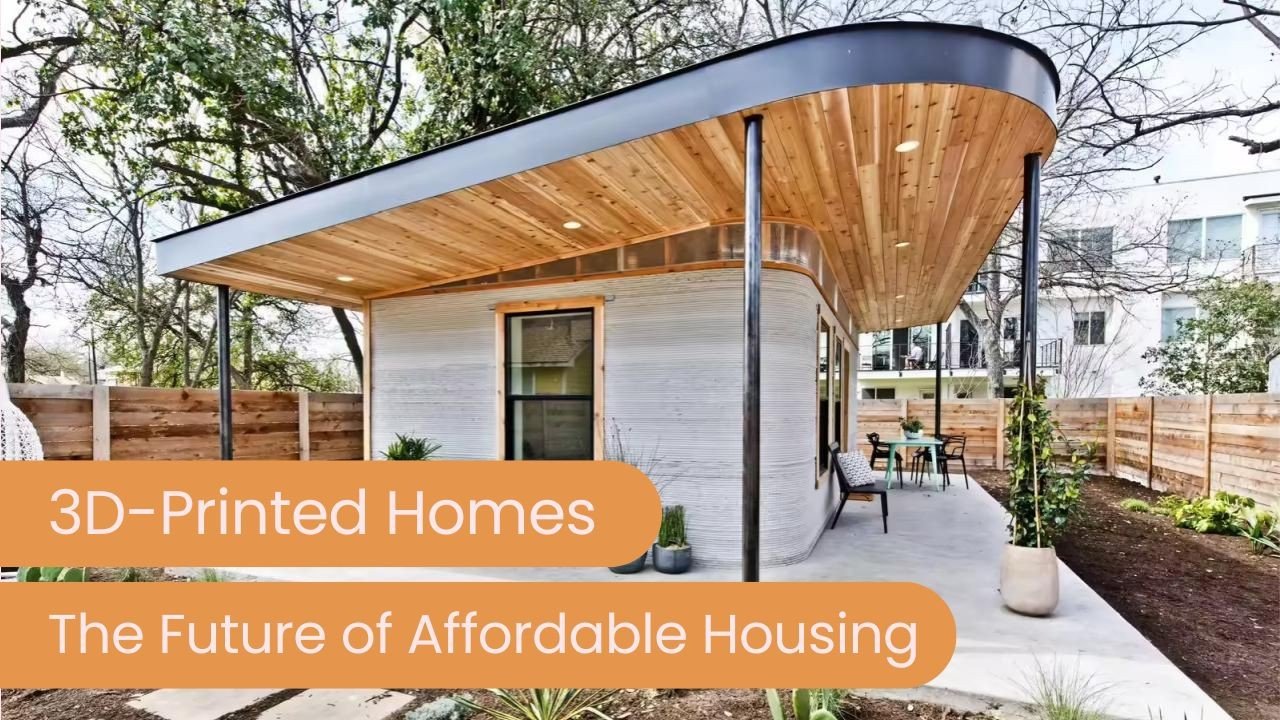
ICON – Austin, Texas
- Printed walls in 24–48 hours
Large community of 100+ homes - Collaboration with Lennar Homes
- Designed for long-term durability and safety
New Story Homes – Mexico
- First-ever 3D-printed community for low-income families
Built for earthquake-prone regions - Affordable and designed for resilience
Tvasta – India’s First 3D Printed House
- Built in Chennai
Completed in just 5 days - Cost reduced by approximately 30%
Dubai Municipality Building
- One of the world’s largest printed buildings
- Strong focus on sustainability
- Printed using local material mixes
PERI Group – Germany
- Printed multi-storey apartment
- Showed the potential for large-scale developments
Mighty Buildings – California
- Producing net-zero 3D-printed homes
Uses clean energy and sustainable materials
Limitations of 3D-Printed Homes (Beginner-Friendly Honesty)
Even though 3D-printed homes are exciting, they’re not perfect.
Here are the current limitations:
1. Not everything is printed
Roof, windows, plumbing, and electrical work are still manual.
2. Limited multi-storey printing
Printing multiple floors is possible, but expensive and complex.
3. Requires skilled technicians
Printer operators and software engineers are needed.
4. Regulations are catching up slowly
Approval processes can delay projects.
5. Doesn’t eliminate all costs
Finishing interiors still costs similar to traditional construction.
Common questions homeowners ask, answered simply:
1. Are 3D-printed homes earthquake-resistant?
Yes. The walls are solid and continuous, giving them excellent structural strength.
2. Do 3D-printed homes crack easily?
No. Because they’re printed in layers, they expand and contract more uniformly.
3. Can you customise a 3D-printed home?
Absolutely. Curves, round rooms, modern designs — all possible at no extra cost.
4. Do 3D-printed homes look different?
They can look futuristic, but you can also plaster and paint them to look completely traditional.
5. Can 3D-printed homes last as long as traditional homes?
Yes — 50 to 100 years, depending on the material used.
6. Are they mortgage-friendly?
Lenders are slowly adopting policies for them. In the U.S. and UAE, many banks already offer financing.
7. Can you build a 3D-printed home in cold or hot climates?
Yes. Material blends can be customised for different climates.
8. Can a 3D-printed home have two floors?
Yes, but usually through a hybrid model (printed ground floor + traditional upper floor).
Myths About 3D-Printed Homes
Myth 1: They are weak
Reality: They are often stronger due to reinforced concrete mixes.
Myth 2: They look ugly
Reality: They can be finished beautifully — even luxury-grade.
Myth 3: They’re only for cheap housing
Reality: Many luxury villas are now being printed.
Myth 4: They melt in rain
Reality: They use concrete, not plastic. Rain has no impact.
Myth 5: Robots do everything
Reality: Printing handles walls, but humans complete the rest.
Future of 3D-Printed Homes
What the next 10 years may bring:
- Entire neighbourhoods printed in weeks
- Disaster-relief homes printed in 24 hours
- More eco-friendly materials
- AI-powered printers
- Fully automated construction sites
Lower-cost sustainable homes - Government-supported printed housing projects
- Printed rental communities
Experts predict that by 2035, 3D-printed homes could make up 20-30% of affordable housing in many countries.
Step-by-Step: How to Buy or Build a 3D-Printed Home
For homeowners who are seriously considering this, here’s a simple guide:
Step 1: Choose a certified 3D-printing construction company
(Check their past projects and approvals.)
Step 2: Pick or design your home layout
Single-storey homes print fastest.
Step 3: Get local building approvals
Companies often help with this.
Step 4: Prepare the site
Land leveling, soil testing & foundation setup.
Step 5: Begin printing
Walls can be done in 24–72 hours.
Step 6: Finish interior work
Roofing, flooring, painting, electricals, plumbing, and cabinetry.
Step 7: Inspection & handover
The home is now ready for move-in.
FAQs for Homeowners
Here are more beginner-friendly FAQs with expert-level insights:
Q. Can I choose any location for a 3D-printed home?
Yes, as long as:
- The land is stable
Printer access is possible - Approvals are granted
Q. Will it feel like living in a ‘concrete box’?
Not at all. Interiors can be finished with:
- Plaster
Paint - Wood panels
- Wallpapers
- Tiles
They look and feel just like traditional homes.
Q. Can printed homes support AC, geysers, and solar panels?
Yes. You can install:
- Solar panels
- Split air conditioners
Smart home systems
Just like any other modern house.
Q. Do printed walls insulate heat well?
Yes. They have:
- Thicker walls
Insulation cavities - Curved surfaces that reduce heat transfer
This makes them very energy efficient.
Q. What maintenance do 3D-printed homes require?
Very minimal:
- No termite treatment
- Less cracking
- Stronger wall structure
- Long lifespan
Q. Can 3D-printed homes be extended in the future?
Yes – extensions follow traditional methods.
Q. Can I get a loan for a 3D-printed home?
Increasingly yes. Banks in the U.S., UAE, and India are now offering financing.
Q. Are 3D-printed homes good for rental properties?
Absolutely. They reduce both construction and long-term maintenance costs, making them ideal for rental portfolios.
Bottomline: Are 3D-Printed Homes the Future of Housing?
Here’s the honest truth:
3D-printed homes won’t replace traditional homes overnight. But…they will play a major role in solving the global housing shortage.
Why? Because:
- They are faster
- They are cheaper
- They are stronger
- They are eco-friendly
- They offer design freedom
- They reduce labour dependency
- They are ideal for affordable and rapid-scale housing
For homeowners, the biggest advantage is simple: A high-quality home at a lower cost and built in a fraction of the time.
So yes – the future of housing is very likely to include 3D-printed homes. And for many families, that future might arrive sooner than expected.
Follow Homecrux on Google News!